Showing posts with label books. Show all posts

Wednesday, November 11, 2015

Get Your Thanksgiving On -- Only Two Markets Left!

Has it been driving you nuts, all the Christmas ads playing already? As a major Thanksgiving fan, I don't need the stress of worrying about Christmas this early. Let's take our holidays in order, people. Which means I should acknowledge Veterans Day before I get on with this post.

Thank you, veterans. May you be celebrated with a home-cooked meal today, which in no way makes up for your service, but it's more than lots of folks get, nowadays.

If you don't happen to have any veterans in your life, here are a couple books I've recently devoured about our soldiers (and the hardships they've faced!):


Now onward to Thanksgiving. With only two Markets left, we have to plan ahead. So this would be the week to buy your usual favorite items, as well as ingredients for a couple make-ahead side dishes. Since we'll be headed over the Pass to see my in-laws, I'm in charge of several side dishes and hope to put a couple in the freezer this weekend: rolls, green bean casserole, cranberry sauce (which keeps forever in the fridge), and possibly the base for butternut squash casserole.

If you've been invited to a friend's and only have to bring beverages, consider some fresh cider from Martin Family Orchards, or a bottle of Washington wine. And don't forget that hostess gift! Maybe some toffee or a pie? Definitely flowers.

Here--I've made your shopping list for you:

apples (I might just get a whole box. The ones in the store are so not crisp.)

pumpkin (for the daring among you. I imagine you could whack it in half and cook it on LOW in the slow cooker, just like I do for butternut squash. Super easy.)

winter squash

green beans

onions

cranberries (hoping we'll see Bloom Creek...)

wine

cider

baked goods (if you don't like to make your own rolls or pies. Buy now and freeze.)

eggs (I'm getting a couple dozen, at least. Eggs keep forever in the fridge, although we blow through them at our house. I'll miss those thicker egg whites all winter!)

And with all the preparing for Thanksgiving, you might be too tired to make your own dinner, in which case I recommend some of the delicious prepared food. See everyone Saturday!

Wednesday, October 22, 2014

Are Healthy Processed Foods an Oxymoron?

You might have seen the headlines yesterday that profits at McDonald's and Coca-Cola dropped in the last quarter. Could it be that Americans are finally turning away from junk food and soda?
Baby, don't hurt me, don't hurt me no more
The answer to that question seems to be Yes and No. Yes, Americans might finally be heeding all the warnings about our favorite junk foods, but, No, we still need convenient meals and snacks. Just give us the "healthy" stuff. The processed foods with added protein, vitamins, fiber, omega-3s, what-have-you.

We'll put down the Coca-Cola and reach for the Vitamin Water. We'll bypass the french fries for the whole-grain cereal. But are the "healthy" alternatives any healthier?

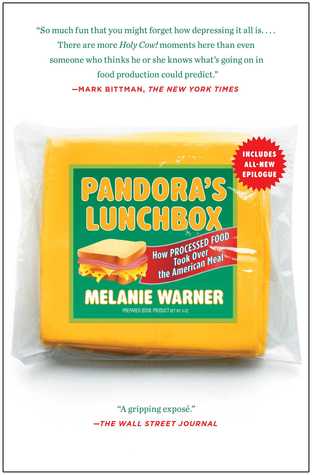
Recently I read another food-industry-investigation book, this one called Pandora's Lunchbox by Melanie Warner.

If you've run the gamut of food books, from Michael Pollan's oeuvre to Salt Sugar Fat and their ilk, you won't find a whole lot new in this book, although I did find a few interesting nuggets:


  •  Digesting a meal of whole, unprocessed foods raises your metabolic rate almost 50% over a meal of processed.
  • When Kraft started producing processed cheese, WI cheese makers wanted it called "embalmed cheese."
  • If soybean oil weren't bleached, it would be reddish-orange and contain beta carotene.
  • There are 2 ways to fix our omega-6/omega-3 imbalance: eat 6-10 ozs of salmon/day (until all the salmon are overfished and gone) or cut back on processed food.
  • Most of the 5000 food additives allowed are industry self-regulated and untested. (Basically a wait-until-somebody-gets-sick approach.)
Warner also includes a chapter called "Healthy Processed Foods," to look into such novelties as "resistant starch," which is "molecularly rearranged to withstand human digestion"--like fiber! Most natural fibers get broken up or removed during processing, so food manufacturers generally have to add it back in. Yes, resistant starch resists digestion, but can it reproduce the complexities of natural fiber, which comes with its own nutrient benefits that the gut processes in its equally complex ways? Who knows.

Warner notes that, "between 2007 and 2011, among the eight thousand packaged products evaluated, healthier choices made up roughly 40 percent of sales but generated more than 70 percent of sales growth." "Healthy" is good business. And "healthy," as defined by the food industry means reducing sugar and fat and generally replacing them with other cheap ingredients: "zero-calorie sweeteners, starches, gums, or taste-modification molecules." Genuine healthier food items require whole ingredients and less filler--hence the high prices of KIND bars which I remarked on earlier.

Can you find healthy processed foods? Since I don't think even a KIND bar can technically be called a healthy food (it's more like a healthier candy bar), the options are slim. There are roasted nuts in cans, frozen fruits and vegetables, unsweetened yogurt, plain old rolled oats. But, as always, the answer seems to be, if you want real healthy--genuine healthy--the only guarantee is to buy it yourself and cook it yourself.

Our farmers market offers the best of both worlds: whole foods from a farmer or vendor who can tell you exactly where it came from and how it came to be, and processed foods, where the vendor can tell you exactly where it came from and what went into it. No weirdness, no chem lab, no fillers.

So, fine, skip the McDonalds and the Coca-Cola. Our Market offers tuna and beef jerky, all kinds of baked goods, yogurt just waiting to be swirled with artisan jam, Hosui Asian pears, roasted peanuts, crisp apples and multiple varieties of pear--all to be washed down with fresh-pressed ciders or even Washington wine. Do these offerings cost more than the storebought ones? Sometimes--in the short run. The final tally on the processed foods won't be determined for years, but if the rising levels of obesity and metabolic syndrome and food allergies are any indicator, those "foods" have their own hidden price tags.

Wednesday, September 24, 2014

Are We Evolved Enough to Eat That?

Great job selecting for desirable traits, early farmers!
If you've read books that mention the history of agriculture, you've learned by now that wild maize bore little resemblance to the crunchy, sweet, essence-of-summer corn we now enjoy. Nah--the wild stuff had few kernels on tiny ears and required plenty of scavenging before you could make a meal of it, much less a bowl of tortilla chips and a gallon of high-fructose corn syrup.

Our hunter-gatherer forbears spent up to six hours a day to accumulate enough calories to feed their small bands, and they ate a diet made up largely of fruits, tubers, nuts, seeds, and wild game. As a result they got plenty of physical exercise, fiber, and enough of a chewing workout to make their jaws grow large enough to fit their teeth--all their teeth. They were also seasonal eaters by default and not too subject to widespread famine, since they could always move on elsewhere or put up with less choice offerings, like rabbits having to eat grass after they're already devoured your pea plants.

After millenia and millenia of such a diet, it only makes sense that natural selection favored bodies that processed such food best, and this story would all have had a happy ending, except that humans decided to start sticking around in one place and farming.

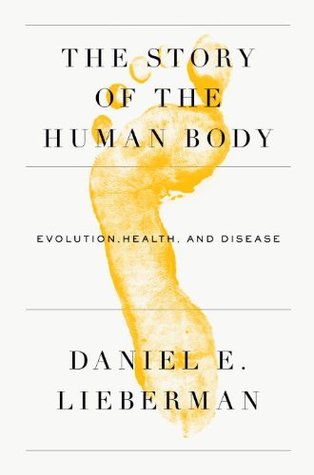
I've been reading again.


Really it was the "health and disease" part of this book that interested me, since I've been wondering about all the different diets and nutritional advice out there. It seemed best to listen to an evolutionary biologist to figure out what exactly are we designed to be eating?

The short answer is: not what we're currently eating. Lieberman classifies many of our modern illnesses as "mismatch diseases," meaning, our bodies now encounter foods and environmental circumstances which are different from what our bodies have come to expect after so many gabillion years, so we get sick. Examples of mismatches:


  • Obesity. Most of us in the developed world experience an energy surplus of food. Our bodies have been designed to sock away fat, so we have a continuous supply of energy to fuel our giant, energy-sucking brains. But we used to experience lean times as well as bonanzas, and now all we have are bonanzas.
  • Type 2 diabetes. Remember that bit about the hunter-gatherer diet? It included hardly any sugar (all pre-agriculture fruits were about the sweetness of a carrot) or simple starches. The carbs we ate had lots of fiber and therefore made our bodies work hard to get energy out of them. Which meant, no sugar spikes in the blood and no insulin spikes and no consequent insulin resistance.
  • Myopia! (Lieberman gave many, many disease examples, but I include this one because I always wondered how nearsighted people could've survived the caveman era.) Back in ye old hunter-gatherer days we were mostly outside and never spent hours with our eyes frozen in flexed position, staring at books and screens. It turns out that the teeny muscles holding up the lenses in our eyes get to relax when they look far away, but nowadays we hold the poor muscles clenched up, focusing close up, with sad, contact-lens-wearing results. Among the few hunter-gatherer populations remaining on earth, you don't find many needing lasik.
There's much much more to the book, but the lifestyle advice is familiar and straightforward. Prevent mismatch diseases by avoiding "stimuli that are too much, too little or too new." 
  • Too much = sugar, simple starches, overly processed foods.
  • Too little = fiber and physical activity (walking is just fine--that's what we're designed to do, along with a little running on our arched, springy feet, when necessary)
  • Too new = environmental pollutants, weird foods like transfats (our bodies are like, what the heck?), high-heeled shoes, sitting for hours
Our bodies are trying to catch up with the crazy brave new world--there's already some selection happening for people to produce more insulin--but all the changes happened so very fast, evolutionarily speaking, that we aren't going to turn those mismatches into matches anytime soon.

So grab extra of those fruits and vegetables and pastured meats at the Market this week, and park your car in the furthest spot in the lot. Oh, and read this book!

Wednesday, August 20, 2014

Summer Fruit, YA Pop Culture Edition

Last night my book club met to discuss that ubiquitous teen tearjerker The Fault in Our Stars. As always, we tried to theme our food to the book.

Here they are, in l-u-v

If you haven't read it, the story is about two teenagers with cancer who fall super-de-duper in love, and I learned that the two stars in the movie also play a brother and sister pair in Divergent, which weirded out those viewers who saw both. Having seen neither, I was good to go.

And here they are in sibling mode
But I digress.

As I was saying, we try to theme the food to the book, so we went with "cancer-fighting." And what fights cancer better than our friends, fruits and vegetables? Since book club takes place after dinner, I have to admit that no one brought a vegetable of any kind, and any cancer-fighting that was going to happen fell to the fruits.

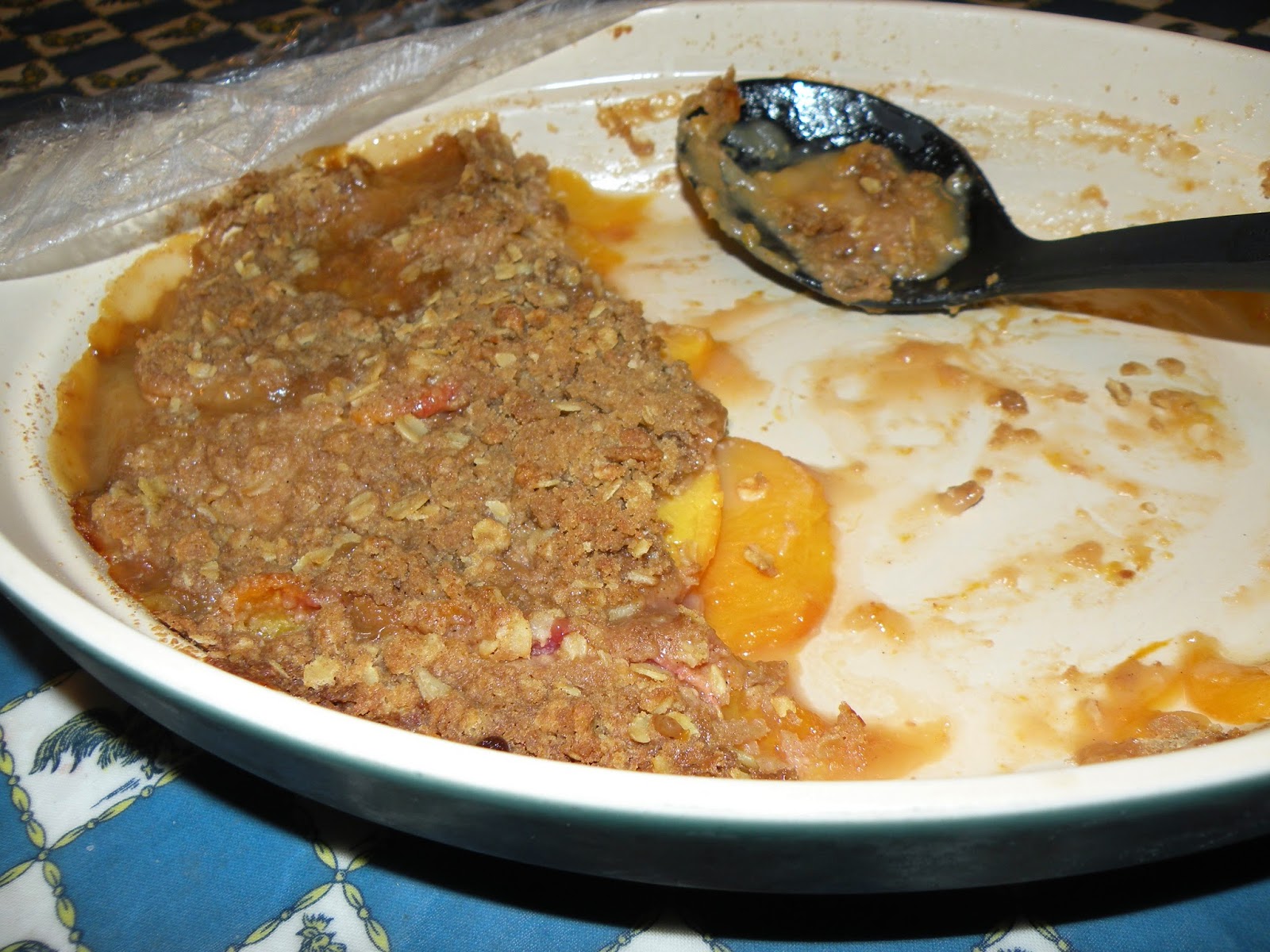
My Peach Crisp (which I neglected to photograph before it was eaten)
There was peach crisp and peach-cherry cobbler and one chocolate cream pie because chocolate is a fruit, right? Or is it a vegetable? A bean or a berry? We need a botanist to step in here.

I know I already went on and on about the fruits in season at the Market, but really--there's more to say.

For example:


My sister has always said that, when they bred the seeds out of watermelon, they also bred out the flavor. After buying this traditional, seedful melon from Alvarez, I am inclined to agree with her. SEEDS = FLAVOR!!!

My lazy kids took some coaxing to try the seedful watermelon, but after they tasted it, there were no more complaints. (I might have given the speech, "When I was a kid, there was no seedless watermelon...etc. etc.") Get one of these melons and see if you don't agree.

Then there's River Farm's Charentais melons:


Like mini-canteloupes, they pack amazing, perfumed flavor, as if everything in the canteloupe had to be boiled down and concentrated. Don't miss these ones either!

This post now ends abruptly. I got a new laptop with Windows 8 and am still in the love-hate, I-love-this-speed/I-am-going-to-throw-the-danged-thing-in-the-street-and-back-over-it stage. But I leave you with this funny recycling idea our book club hostess had, for those darned plastic honey bears. See? Perfect for dish detergent, and much more winsome than the branded bottle!


Wednesday, July 16, 2014

In Praise of Fresh

Wow. Summer is going strong, and if you aren't eating Market fresh yet, let me persuade you not to miss this! Take just one, eeny weeny example:


It's green bean season, people. They're skinny and crisp and flavorful, and they're on our dinner menu just about every day this week. So far we've had them two ways, both so delicious that I had to share them with you. As always, ingredients found at the Market are marked with an asterisk (*).

Green Beans with Bacon and Goat Cheese
1 lb green beans, trimmed*
1 Tbsp butter
2-3 slices bacon*
1 dried-fig-encrusted goat-and-sheepmilk cheese from Tieton Farms* (1 little cheese is enough for 2 recipes)

Steam beans till crisp-tender. Drain and add butter. Season with salt and pepper. Crumble cooked bacon and cheese over and serve warm or at room temperature.

Once you've run out of the awesome cheese, you might want to try a more international recipe. My book club met last night, and as always, we tried to theme the food to the book. In this case we had read Lost in Shangri-La, a fascinating nonfiction account of a plane that went down in WWII in a highland Papuan valley. The survivors of the wreck encountered Papuan tribespeople with Stone Age technology, who had never before seen white people or modernity.

 I highly recommend it for WWII and adventure buffs or those with an anthropological bent. One of the members of our book club had lived as a missionary in Wamena and knew all the places mentioned in the story, so we had her draw up a typical Indonesian menu for us, for which each of us prepared a dish. Everything was so tasty that most of us went home uncomfortable, but a particular hit were the "Buncis Tumis," the stir-fried green beans. Thus:

Buncis Tumis
 
Heat in a wok or large skillet:
2 Tbsp Coconut Oil
2 tsp crushed garlic (3-4 cloves)*
2 tsp grated ginger (about a finger length)
 
Add:
½ sweet onion, sliced to shape of green beans*
1 cup sliced carrots, sliced in shape of green beans*
2 cups green beans, cut in 1-2” lengths*
½ cup water
2-3 T kecap manis (sweet Indonesian soy sauce found at Asian markets)


Stir fry until beans just begin to grow tender, maybe 3-4 minutes.
Remove to serving dish.  Toss well with fresh ground black pepper.

Clockwise from top: Chicken Curry, Buncis Tumis, Turmeric Rice, Gado Gado ("Mix Mix")
As long as you're stopping by Uwajimaya or the Asian Food Market for kecap manis (pronounced "ketchup mayonnaise," if you need to ask the clerk), you might as well grab some Indonesian Gado Gado dressing or a packet of "Bumba Gado Gado" (Gado Gado Spices) to make your own. Then just make up a tray of your favorite fresh items--
  • potatoes, boiled and cubed*
  • cucumbers, peeled and cubed*
  • boiled eggs*
  • tomatoes*
  • green beans*
  • sweet potatoes 
--sprinkle cilantro* over and drizzle with dressing. You can also squeeze fresh lime over it. 

And lastly, while I'm on the subject of fresh, did you notice the newly-caught salmon from Two If By Seafoods?

From the bin labeled "Grill Me"
 Get 'em while they last!
 

Wednesday, December 4, 2013

5 Christmas Books for The Foodie In Your Life

As I reviewed 2013 on Goodreads, I realized I read fewer foodie books than normal, possibly because I was getting tired of the standard foodie-memoir format: gal at a crossroads in life goes somewhere else and finds herself through cooking, food, and some kind of romance. Insert [Name], insert [Exotic Place], insert [Recipes too Complex for the Reader to Bother With], insert [Foreign Boyfriend's Name], insert Implied Happily Ever After (even though the writer is only in her thirties). It's like Memoir Mad Libs. If this formula is new to you, and you would like to read such a book, just ask at the bookstore and they can direct you to shelves of them.

But in the meantime, I have collected five food- and/or environment-related books that I learned much from and enjoyed, in hopes that you or a loved one with similar interests might like to find one under the tree this Christmas.

In no particular order:

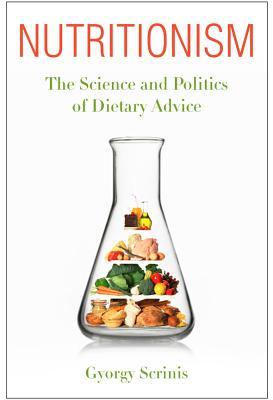
1. Nutritionism by Gyorgy Scrinis.

It's put out by a university press, so it can veer a little academic, but I highlighted this book like crazy. Basically, Scrinis argues against viewing foods as nutritional delivery systems, to be tweaked according to the latest fads. (I'm looking at you, eggs with added omega-3s.) First of all, eating food is not the same thing as taking a supplement of the targeted nutrient. No one exactly knows how food interacts holistically with other foods and with the body to do that voodoo that food does so well. Of far more interest and importance in Scrinis' eyes is the amount of processing a food undergoes--many high-tech ingredients and processing methods have not been studied for their effects. They just don't happen to be illegal, so in they go. Think of the delightful trans fats we all ate plenty of for years until someone figured out they're not so great. Scrinis says the jury is still out on the new ways of processing fats that manufacturers developed. The new fats aren't trans fats, but they're not fats found in nature, either. That's just one example. Just about everything food-related comes in for scrutiny: the latest diets (--Cough!--no-carb and Paleo), the glycemic index, food labeling, Michael Pollan arguing in circles, you name it. A fascinating, recommended read.

2. Speaking of Michael Pollan, I really enjoyed his latest

A long, at times meandering hymn to the wonders of cooking processes that few people have experience with anymore, from wood-roasting pork (barbecue), to braises, to bread baking from wild yeasts, to fermenting just about everything. As an everyday cook I was still amazed how much I learned, and how many modern crutches I continue to use (e.g., commercial yeast). I'm dying to try my own sourdough starter now and to pickle something, although both processes sound mind-bogglingly involved and time-consuming.

No idea why this book has drawn criticism where it has--Pollan in no place says women should get back in the kitchen. Certainly few people--male or female--have the time or perseverance to attempt mastering the skills Pollan writes about, but many, like me, might pick one or two experiments to try.

Worth the read.


3. For the foodies in your life who are also history buffs:


A quick, interesting read for Jefferson fans and foodies alike. How his years in Paris and traveling in France and northern Italy influenced both the man and the national cuisine. The dealings with James Hemings, Jefferson's slave and legally-unrecognized brother-in-law also fascinate. Don't look for much of sister Sally here, though.

4. And then there are the lovers of all things artisanal:

A foray into the ultra high-end world of bespoke clothing. Author Noonan hunts down vicuña shearers in Peru and fabric weavers in the Brontes' old stomping grounds of Yorkshire. There are passages on Beau Brummell and buttons and how hard it is to find an apprentice nowadays. After you read this, you'll be trolling the vintage clothing stores, looking for natural materials and lost craftsmanship.

5. Finally, for the environmentalist in your life (a Venn diagram of Marketgoers and environmentalists would probably show a distinct overlap):

This was one excellent book. Informative, fascinating, alternately depressing and hopeful. As a culture we are being buried in trash--especially plastic and food waste. Humes follows the history of waste "disposal" without righteous hand-wringing or drama. The situation is dramatic enough and the conclusions obvious without all that.

I came away considering a plastic fast in our family--using and recycling the last of the plastic wrap and existing bags and containers, but trying, trying, trying to minimize/eliminate them after that. Just about everything is made of plastic or comes in single-use, disposable packaging, so I don't even know if it's possible unless you go whole-hog like the families that write the Zero-Waste books.


A lovely, cleansing read for the post-Christmas hangover that is the month of January. 

That's the UrbanFarmJunkie's reading year in review. Hope you find something here to share!


Wednesday, March 27, 2013

Literary Passovers and Easters

Happy Passover or Easter to you all!

Having been raised as a child with no religion at all, everything I learned about these holidays I learned from books. Take, for instance, Passover. Sydney Taylor wrote a wonderful series based loosely on her childhood, growing up in the Lower East Side of turn-of-the-century New York City, and her books served as my introduction to feasts like Passover, Purim, and Succos.

When Passover rolls around for this family, all the girls but mischievous Henny have been laid low by scarlet fever, but Taylor carefully describes what is found at the Seder meal and why. While the sick girls listen from the bedroom, the parents and Henny read the stories and perform the rituals and share the meal: wine, "matzoth," bitter herbs, hard-boiled eggs dipped in salt water, and then "chicken soup with matzoth balls (dumplings made of matzoth flour), chicken, vegetables, and stewed fruit.

On our recent trip back to New York we ventured down to Broadway and Canal and Orchard Streets to recapture a feel for the All-of-a-Kind Family era, where the family goes to the Rivington Street Market for fish and vegetables, candied fruits and Henny's pickle, all sold from the dozens of pushcart vendors.

The turn-of-the-century vendors are gone, but there were still plenty of pushcarts selling nuts and hot dogs, now manned by more recent immigrants. If you don't get around to picking up the books, the Huffington Post linked to this chicken soup recipe that the girls might have eaten at Passover.
[Photo: Cooking Light, 2012]


Two more favorite childhood book series for me were, of course, Laura Ingalls Wilder and the lesser-known Maud Hart Lovelace, and for Spring Break this year (which in the Bellevue School District has no connection whatsoever with either Passover or Easter in 2013) I've planned a girly literary pilgrimage with my daughters to Wilder's and Lovelace's stomping grounds. Yes, we're off in a couple weeks to wade through Minnesotan slush to explore Plum Creek and Lovelace's "Deep Valley" (Mankato). Now, Easter doesn't come up for the Ingalls family (they seem to be all about Christmas), but it rates frequent mentions in Lovelace's Betsy-Tacy books. Her Ray family, like Sydney Taylor's, tends to celebrate with hard-boiled eggs and chicken dinner, but in one spin-off book, Emily of Deep Valley, Emily visits Mankato's "Little Syria," populated by Lebanese immigrants, and shares their Easter foods. She makes particular mention of "Easter sweet cakes which were buttery, like doughnuts, and spicy. Kahiks, they were called."

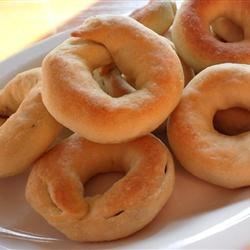
Sounds tasty, but "kahiks" don't come up on a search. From the shape, they could be these "Lebanese Easter Cookies"
Lebanese Easter Cookies [Allrecipes.com]
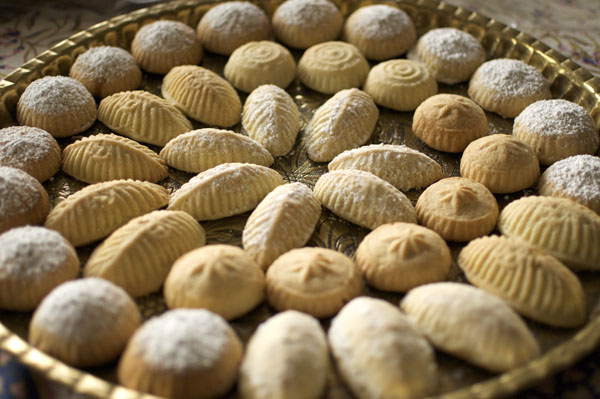
or something called "Ma'amoul"--cakes stuffed with dates or sugared walnuts/pistachios. While I found this recipe for the latter, they look way too complicated, despite their beauty and my love for sugared pistachios.
Ma'amoul [from TheFoodBlog]
At least I can stick with the ubiquitous hard-boiled eggs, which appear across cultures and traditions. Old eggs work best for boiling and peeling, but if, like me, you forgot to stockpile, Tamar Adler has this suggestion in An Everlasting Meal: "I find that after a few minutes in an ice bath, once water gets under shells and loosens them, they come off fairly easily." Let's hope she's right.

Have happy holidays, and take advantage of the time off to read a good book!

Wednesday, December 19, 2012

Favorite 2012 Reads for the Foodies in Your Life

According to Goodreads, I read eleven food-related books in 2012, not counting the couple I tried and abandoned. If you find yourself on December 19th (or later), with no ideas in the pipeline for the foodie in your life, consider a book! (Or, alternately, if some of your recent kitchen-gift concoctions have gone woefully awry...)

You may have seen some of these at the Bellevue Farmers Market, those times we hosted Readers to Eaters. They can also be found at the wonderful University Book Store Bellevue, which gift wraps in the loveliest papers and ribbons for free. They also ship media rate gratis, so if your recipient doesn't mind lateness, that option is still open for you. For friends with ereaders, these books can be found in the usual cyber places, and University Books now sells Kobo ereaders.

And now, without further ado, my 2012 favorites:

Best Memoir
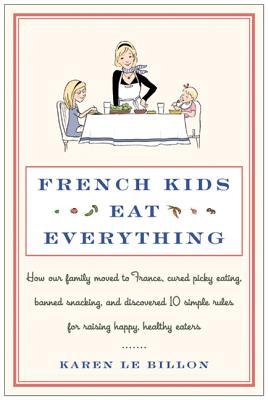
Le Billon undergoes food culture shock after moving to France. The book combines memoir with cultural studies with parenting. I can't say it changed what I fed my family (though it did cure us of car snacking for about three days), but it made me wish I could start over with my kids, food-wise. I posted a more complete review here.

Best History
Granted, I only read three food histories this year, but this one was the most consistently informative and fascinating. Pretty self-explanatory. Pair it with your favorite peanut butter and you're set! As promised, here is my extensive Goodreads review of it.


Best Exposé


An astonishing, informative, heartbreaking, and ultimately hopeful book about the tomato in general and the conventional tomato industry in Florida, in particular. Halfway through I was vowing that, should I ever find myself on the East Coast, I wouldn't touch a single conventionally-grown tomato, in protest of the dreadful working conditions; rampant lethal pesticide and fungicide use; and--let's face it--awful hardness and lack of flavor. By the end, however, Estabrook had me feeling optimistic about the dreadful working conditions, at least. Not only had major fast-food chains and Whole Foods signed on to pay a wee bit more for fairer worker treatment, but nonprofit private groups were improving worker housing and job conditions. With the momentum going that way, I imagine the other grocery store chains will follow eventually. The things may still taste like big, watery NOTHING, but at least no one would be poisoned, enslaved (not kidding) or dying, so that I could have chunks of the big, watery NOTHING in my winter salad.

A couple interesting facts I learned about tomatoes in general:

1. They were declared a "vegetable" by the Tariff Act of 1883 to protect American farmers from Caribbean imports.

2. "All varieties of cultivated tomatoes that have ever been bred contain less than 5% of the genetic material in the overall tomato gene pool" (p.12). Yes, all those different sizes, colors, shapes, and flavors found even at the best farmers markets are very similar at the DNA level--inbred, feeble, and vulnerable to just about everything.

3. An acre of FL tomatoes receives 5x as much fungicide and 6x as much pesticide as a CA tomato.

Your best bet? The local farmers market. If you didn't know already, tomatoes grown in soil and picked when ripe have the best flavor. And you can ask the farmer himself about how he treats and pays his workers.


Best Scary Book
This one doesn't really count because it's not available until December 27. I suppose Lustig and his publisher figured no one wanted to hear this news before Christmas. Per my earlier post, this is quite the book. I swore off sugar for all of two days before succumbing to Christmas cookies and some kind of almond cake, but I vow to try again in January.

In other news, I roasted my Skagit River Ranch turkey, and we're taking on the 13-Meal Challenge again. The tally so far:

1. Fancy turkey sandwiches.

2. Turkey a la King.

No post next week, but do enjoy your holidays!