Showing posts with label Kitchen Counter Cooking School. Show all posts

Monday, December 31, 2012

2013 New Year's Food Resolutions

Last year I listed twelve possible New Year's Food Resolutions your family could adopt and suggested giving ONE a spin. Which one did you choose, and how did you do?

According to a recent Wall Street Journal article, 60% of people have given up on their resolutions within six months, a figure I found surprisingly low. After all, the gym always calms down by March, and I figure "exercising more" must make the Top Two of Perennial New Year's Resolutions. Last year I aimed for the much lower bar of "take the stairs when they're an option" and have prevailed, although I admit I am rarely in places where stairs need to be taken because I spend a disproportionate amount of time parked in front of my computer. Basically it amounts to dragging my children up countless flights from Level 4 of the Lincoln Square parking garage to the cinemas at the top, the few times a year we go to the movies.

In any case, I've picked a couple New Year's Food Resolutions for 2013 and have tips for other ones:

1. Learn to make a decent loaf of artisan bread so I won't have to buy them at the store. This doesn't mean I'm giving up breads from the Bellevue Farmers Market by a long shot--I just want to have an option for your basic whole-wheatish loaf with a crunchy crust and something to eat in the off-season. Kathleen Flinn's book The Kitchen Counter Cooking School turned me on to "No-Knead Artisan Bread," which I plan on trying. I'll report back.

2. Swap out one kid snack food for something healthier. My thirteen-year-old asks me consistently to replenish "the snack shelf," i.e., the place where pretzels and crackers and chips are found. My son asked me to buy granola bars. After having reviewed Robert Lustig's excellent and alarming book Fat Chance, I'm determined (after getting through Christmas-cookie season) to reduce the amount of sugar and meaningless calories my kids consume, so they don't join the 40% of "normal-weight" individuals who harbor insulin resistance, that dreaded precursor to chronic metabolic disease. That means I'm going to make the effort (for at least six months, until I give up) to cut up fruits and make dips for cut-up vegetables. I'm going to slice cheese. I'm going to try recipes for homemade granola bars, starting with this one.
(Pic of Ina Garten's recipe courtesy of Penniesonaplatter.com)
No idea how it'll go because my son dislikes dried fruit. Might have to substitute chocolate chips, which hopefully won't completely negate the effort.

That's it! Don't want to bite off more than I can chew, so to speak.

But if you chose the resolution from last year to "substitute one homemade product for a storebought processed food," I have a couple more finds for you, both of which I have tried and found delicious. The first, perfect for leftover turkey, is Homemade Enchilada Sauce. The second, also perfect for leftovers and many, many casserole and crock-pot recipes is Homemade Condensed Cream of Mushroom Soup. Uh-huh. No more "open a can of..." I didn't have mushrooms and just made "condensed cream soup," and it worked wonderfully for turkey tetrazzini. Next time I make it, I might double the recipe and freeze half. You're welcome, and Happy New Year!


Tuesday, December 6, 2011

Five Christmas Gifts for Your Food-Lover

It works for her! (Photo: Good Housekeeping)
And, really, who isn't a food lover? There are the occasional oh-so-superior people who don't like sweets (!!), but these, thankfully, are few and far between, as natural selection keeps them to a minimum. (Who could date--much less marry and have children with--a person who, after dinner, carelessly passed on dessert or chocolate when you yourself were dying for some?)

Food-related gifts can't be beat at Christmas for so many reasons, including:
  1. They don't junk up the house and end up in a Goodwill bag a few years down the line.
  2. They don't break.
  3. They are frequently shared with the recipient's family, if not with the very giver.
  4. They can reap benefits for all involved in cases like restaurant gift certificates, cookbooks, or actual food (see #3).
Therefore, if you were thinking of reaching for another tie, pair of slippers, Barnes & Noble gift card, or what-have-you, consider these suggestions instead.

(1) A meal at a new restaurant. Forget the big chains--we had some great chefs visit the Bellevue Farmers Market over the past few years, and in the Market off-season we can still sample their tasty food locally. A partial list:
    • Cantinetta Bellevue for Tuscan-inspired Italian food incorporating Pacific NW ingredients.
    • Seastar or John Howie Steak. Most likely you've eaten at one of John Howie's restaurants already, but who ever objects to a repeat visit?
    • Bradley Dickenson's stylish Pearl. Fresh seafood, steaks, NW ingredients, and local vegetables.
    • And the venerable Bis on Main for French/Italian/Delicious.
    • If gift certificates aren't your thing, consider a scavenger hunt with clues ending at the restaurant, or even a "kidnapping" on a certain date. Design something related to these to put under the tree.
(2) Food itself. I've got Market-made jam, peanut brittle, salmon, and honey waiting to be handed over as-is or incorporated in homemade food gifts. Many of the vendors featured at the Bellevue Farmers Market can be found at other local farmers markets (use the locator link from my previous post) or in specialty stores. Get creative! How about a Local-Food-of-the-Month Club? Doesn't have to be big. Just some seasonal produce or cheese or beef jerky or whatever. Something to look forward to.

(3) How about a cooking class? Talk about a gift that keeps on giving. And if you've read Kathleen Flinn's THE KITCHEN-COUNTER COOKING SCHOOL, which I reviewed here, you know something as simple as learning to use a knife properly can change someone's life. Flinn offers a link to video cooking classes, which I haven't checked out, but plenty of local places offer a Knife Skills class.

(4) A cookbook. Yes, I cook using online recipes frequently, but it's not my favorite. I don't want to print the recipes out (waste of paper) or write them out (too lazy), so I end up bringing my laptop into the kitchen, a habit that will one day end in disaster. I still love a good cookbook. If your friend has too many cookbooks already, consider a homemade album of your absolute favorites? I bought mini photo albums one year and typed up ten of my go-to recipes for the bread machine. My mom still uses hers!

(5) A book about food. I've mentioned many on this blog, and many have hit the bestseller list. They do tend to get political, given the state of food in America, so keep that in mind. Some past ideas:
    • Little Heathens by Mildred Armstrong Kalish. A memoir of growing up on an Iowa farm during the Depression. Talk about self-sufficiency! Sad how much food Iowa must import now because it's all gone the way of corn and soybeans.
    • The Kitchen-Counter Cooking School (see above).
    • Animals in Translation by Temple Grandin. More a book about how her autism gave her a better understanding of animals. Grandin has worked in the livestock-processing industry and her experiences are moving and eye-opening.
Hope this helps. Feel free to recommend other books or food-gift ideas in the comments!

Tuesday, September 13, 2011

My father-in-law's guilty pleasure is a game show called Baggage. In this twist on The Dating Game, contestants choose from among potential dates who gradually reveal their...baggage, with each round disclosing worse and worse revelations of the junk in their trunk. Just when you think, "Better pick Gal #2--Gal #1 is t-r-o-u-b-l-e," Gal #2 goes on to admit she's in relationships with two prisoners. Yep, the show is a cultural train wreck, and you can't take your eyes off of it.

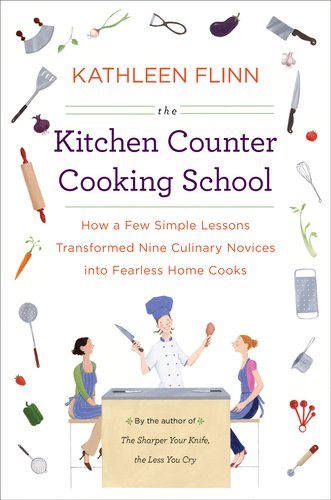
Writer, cook, instructor, and Cordon Bleu Paris graduate Kathleen Flinn hooks readers Baggage-style in her latest book, The Kitchen Counter Cooking School, going through the grocery carts, pantries, refrigerators, and food-related baggage of a dozen different women in the Seattle area. After performing these audits, she has each woman prepare a typical meal for her. She discovers--as every would-be dieter knows--that our relationship with food and cooking is complex and emotional. We eat what we eat, we cook or don't cook, based not only on surface factors like convenience and taste, but also on our associations with those activities. Did anyone teach us how to cook? Did anyone say anything disparaging about our cooking abilities? Do we cook or not cook to embrace or avoid certain assigned roles? What do certain foods signal to us? One woman confesses to a Gold 'n' Soft margarine addiction; she grew up with it, and to the very end of the book, butter tastes odd to her. Another digs a pack of four-year-old chicken parts from the freezer--not having any idea what to do with it, she's let it sit year after year. Still others open crisper drawers on liquefying lettuces or discover warehouse-store-sized "deals" that turned out to be not so thrifty when they couldn't be finished before they spoiled.

Flinn's investigations reveal both the alarming and the familiar, sprinkled throughout with interesting food facts. When one mom complains about her son being a picky eater, only liking the usual, highly-processed kid foods, Flinn cites another book, noting, "Many of the foods on the common kid-food list--chicken nuggets, powder-based mac and cheese, fish sticks--have been engineered to stimulate pleasure centers in the brain. Studies found that, as a a result, rats can become addicted to junk food in the same way that they do to cocaine or heroin." Put down the mini corn dog and back away, Johnny!

After the kitchen audits, which I found the most fascinating part of the book, succeeding chapters detail a series of cooking lessons Flinn offers the women, covering everything from knife skills to trusting your taste buds to making your own bread and stock. While this is familiar ground for anyone who does cook, the book is replete with great ideas, recipes and inspirations. I'm eager to try the no-knead artisan bread and to finish off the last of the salad dressing bottles so I can concoct my own. I'm also eager to challenge myself with reducing wasted food. As Flinn points out, most families could painlessly cut their food bills by just buying what they'll actually use. Now why didn't I think of that?

Each woman comes off better for her experiences, whether in big changes of eating habits or small starts like replacing a fast-food visit with a packed sandwich or foregoing the additive-laden pancake mix. I highly recommend this book, especially if you find Michael Pollan's works too daunting and just want to improve your eating and cooking habits, one tick at a time. To paraphrase Terri, a former alcoholic featured in Kitchen Counter, just as with kicking alcohol or other bad habits, if you try to change everything at once, it never works.

Make a small start this week. Hit our Bellevue Farmers Market for something fresh. Sharpen your knife, heat up your pan, add a little something leftover from the fridge, and go!

(Note: I read Kitchen Counter Cooking School in a complimentary Kindle galley from the publisher in return for a review. This was brave of them because, in writing about Flinn's earlier book The Sharper the Knife, the Less You Cry, I had permitted myself some snarky remarks.)