Showing posts with label Artisan Bread in Five Minutes a Day. Show all posts

Wednesday, April 17, 2013

Organic Tightwad Homemade Options Update

If you've been following the blog, you know I've been experimenting with homemade, healthier, thriftier options to storebought products this summer, and I thought it was time for a results round-up.

HOMEMADE ARTISAN BREAD. Experimenting with ArtisanBreadinFive.com's books and recipes, I whipped up white artisan bread, a mixed-grain, and a mostly whole-wheat version. The white version comes out the most beautiful, but it's hard to justify white bread nowadays, so I stick with the mostly whole-wheat recipe. The recipe calls for sprinkling it with mixed seeds--now I just use one kind of seed and it mostly falls off when you slice the bread.
Effort Rating: Minimal
Taste Rating: Delicious
Tightwad Rating: Highly Recommended


HOMEMADE SANDWICH BREAD. I used the recipe for mostly whole-wheat bread, which is enough to make two sandwich loaves like you might buy at the store. (The nine-year-old did not like the bread made from their "Soft Whole Wheat Sandwich Bread" recipe because she said it was too crumbly. Therefore I used their basic healthy bread boule recipe.) Bake, cool and slice. Excellent crumb and flavor. None of the sugar and additives and preservatives found in even the best storebought sandwich breads. Tip: after slicing, slip a piece of waxed paper between each slice, then reassemble loaf and freeze. Whenever someone wants a sandwich or toast, they can easily pull off as many slices as he needs.
 Effort Rating: Minimal
Taste Rating: Delicious
Tightwad Rating: Highly Recommended
Sliced, papered, and frozen!


HOMEMADE WHOLE-WHEAT BAGELS. Another use for the mostly whole-wheat recipe. ArtisanBreadinFive.com's recipe was for cinnamon-raisin bagels using the basic boule dough, but I couldn't be bothered to add those in, and besides, no one in the house but me likes raisins in baked goods. Real bagels require both boiling and baking, and these were real bagels.
Effort Rating: Considerable but not difficult, because of the shaping and multiple steps. 
Taste Rating: Delicious (My kids have requested I make another batch, but I haven't yet.)
Tightwad Rating: Recommended


HOMEMADE SOUR CREAM. In my zeal to get rid of plastic containers, I gave homemade sour cream a whirl. Same recipe, two attempts. The first was pretty good and actually thickened up nicely after a week(!). The second tasted okay but never thickened at all. In neither case did I like it as well as storebought, with all its thickening agents. Might try a different recipe in the future.
Effort Rating: Minimal
Taste Rating: Fine
Tightwad Rating: Storebought is actually cheaper


HOMEMADE POWDERED LAUNDRY DETERGENT. Tried this here. Ingredients are found at Fred Meyer.
Effort Rating: Minimal
Effectiveness Rating: Great! Couldn't tell the difference between this and storebought.
Tightwad Rating: Not a whole lot cheaper than storebought, when storebought is on super sale.


HOMEMADE LIQUID LAUNDRY DETERGENT. A little more work than powdered detergent, but a whole lot cheaper! Pretty easy to cook up. The concoction thickens on cooling and setting, so it takes some squeezing to get it out of the container, but then I just hold it under the pouring water as the machine fills, and that breaks it up.
Effort Rating: Involves the stovetop, but pretty straightforward.
Effectiveness Rating: Great! Couldn't tell the difference between this and storebought.
Tightwad Rating: Highly recommended. Much cheaper than storebought.
The consistency of phlegm, but it works.


HOMEMADE GENERAL HOUSEHOLD CLEANSER. Tried recipes from a couple different books (scroll down). Nothing kills like harsh chemicals, but if your house isn't a pit like mine, these will probably do the trick.
Effort Rating: Minimal
Effectiveness Rating: Mild, general-purpose cleanser.
Tightwad Rating: Recommended


CHLORINE BLEACH ALTERNATIVE. Substitute 1/2 cup hydrogen peroxide per load. Not homemade but still pretty cheap and easy on the environment.
Effort Rating: Uh, you buy it.
Effectiveness Rating: Not as blinding as chlorine bleach but just fine and no stink.
Tightwad Rating: About the same as chlorine bleach.


HOMEMADE DRAIN CLEANER. Tried this here. Totally effective and environmentally harmless!
Effort Rating: Involves the stovetop, but pretty straightforward.
Effectiveness Rating: Great! Couldn't tell the difference between this and storebought.
Tightwad Rating: Highly recommended. Much cheaper than storebought.

Wednesday, March 6, 2013

Feed the Dirt Pennies a Load

As I reported in my Laundry post a couple weeks ago, making my own powdered detergent was a piece of cake, once I located the ingredients, but it didn't actually save mucho dinero over finding planet-friendly laundry detergent on super-de-duper sale. Nevertheless, the powdered batch took care of two weeks' worth of laundry for a family of five, and I still have enough for one more load.

However, the authors of The Country Almanac of Housekeeping Techniques That Save You Money promised their concoction of liquid laundry detergent cost only "pennies a load," so I had to try that next. No, I wasn't going to make my own fireplace bellows or build the kids a "simple solar cooker" or "Make Recycled Sandals from Rubber Tires" (other projects in the book), but this I could manage.

It took a little planning ahead because I needed two one-gallon containers. At our family's milk-drinking rate, that required a four-day lead time. But otherwise the main ingredients were the same: soap flakes, Borax, and washing soda. In particular they said you could grate 1/3 to 1/2 a bar of Fels-Naptha laundry soap or solid Co-Co Castile soap, but in my laziness I bought pre-flaked soap off Amazon. Fred Meyer carries the Fels-Naptha, the Borax, and the washing soda, all right next to each other.


Ingredients:
1/3 to 1/2 bar of Fels-Naptha or Kirk's CoCo Castile soap
4 cups water
1/2 cup washing soda
1/2 cup borax
1 Tbsp essential oil (I skipped this)

Since 1/2 of a Fels-Naptha laundry soap bar would weigh 2.25 ozs, I weighed an equivalent amount of soap flakes:


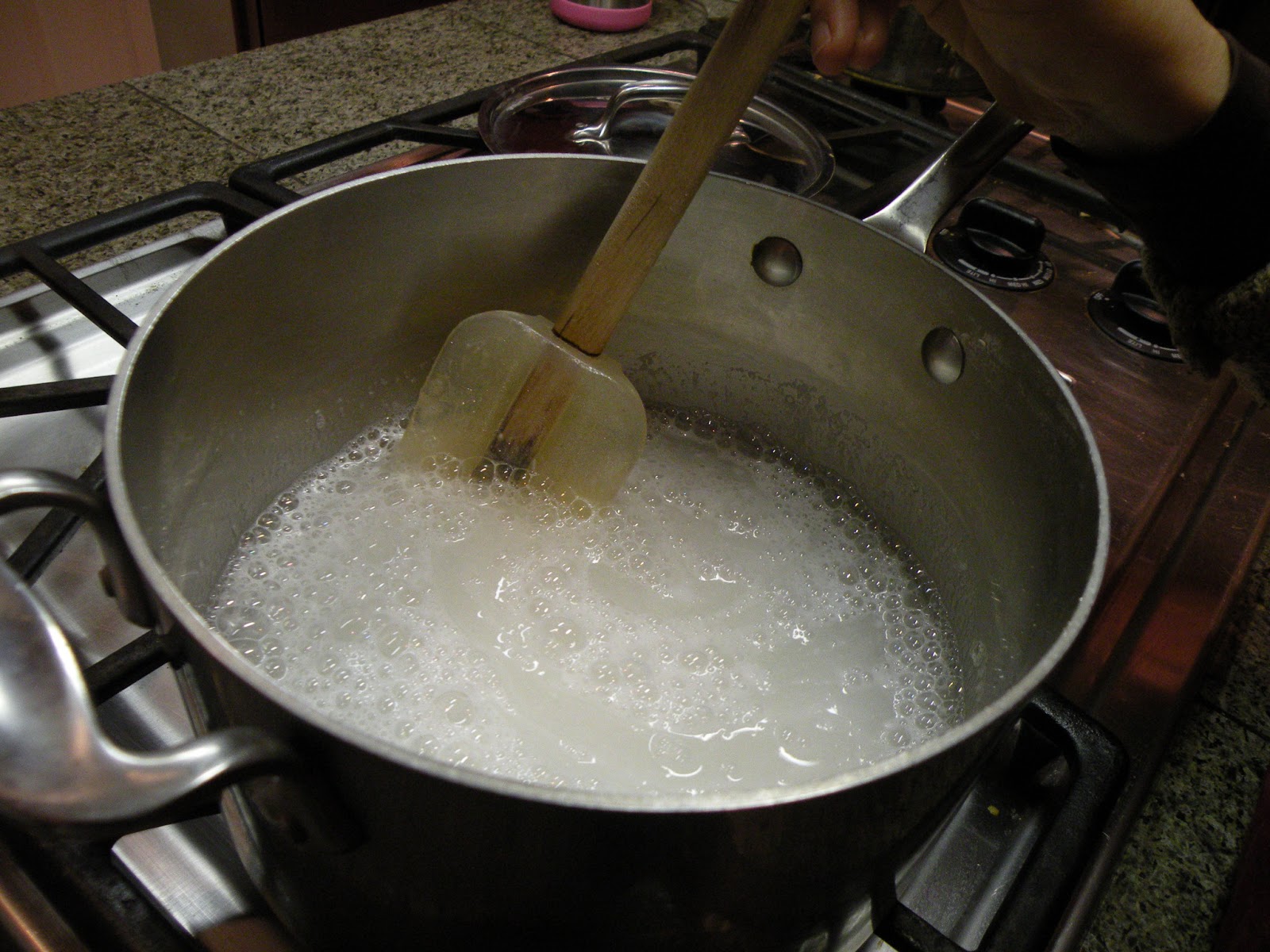
Next, I added the soap flakes to the water and heated over medium until the flakes dissolved.

(The froth is from stirring. It isn't boiling.)
Then I added the remaining ingredients and stirred until dissolved.

Once dissolved, the mixture sat for five minutes over the heat. It said "stir occasionally," but I got distracted and didn't stir at all until the end, and no harm seemed to come of it.

Remove from heat and allow to cool five minutes.

I filled each milk jug halfway with hot tap water. Then I poured half the soap mixture in each jug, shook it, and filled it the rest of the way with warm water. I shook it again and then stored it in the utility room cabinet to await laundry day. (The book recommends letting the mixture sit for 24 hours.)

Voila!
Just in case, I wrote the directions right on the jug. In fact I wrote several labels on the jugs, not out of fear my children would drink it, but more because my absent-minded husband might. I don't imagine he'd go looking for milk in the utility room, but if I happened to leave it on the washer, I wouldn't put it past him.

Considering the liquid recipe used less soap, Borax, and washing soda, and that it promises up to 50 loads (instead of just 12), this indeed qualifies as an #OrganicTightwad post. But I'll definitely let you know how it cleans. The powdered detergent was great, so I have high hopes.

And a closing note from my other tightwad front: artisan breadmaking. (See this post and this one and this one.) My quest to replace storebought sandwich bread was half-successful. Meaning, my husband and son were just fine with homemade (hub even preferred it strongly), but my youngest thought it was too crumbly in a school lunch, and the oldest didn't want it for toast. Sigh. I'm going to try the recipe again, to get my ingredients more uniformly mixed and the loaves closer to storebought size. They looked great, though, didn't they?

Easy to slice, too.


Wednesday, January 30, 2013

Sneaky and Not-So-Sneaky Fiber

Magazine's pic. It's a normal-sized pie, despite scale of that fork!
 Only two more days until blessed February begins and Sugar-Free January takes itself off for another year. My hub is already planning the Chocolate Banana Dream Pie he'll make to celebrate. From an old issue of Eating Well magazine, this has been a personal favorite of his ever since its appearance. I'm thinking of marking the occasion with an ice cream sandwich, but all in all, skipping sugar for a month wasn't too awful--especially after reading Fat Chance and giving myself a good scare. Not only did I manage to lose a few pounds without any more exercise than I was putting in in other, sugar-full months, but I'm hoping I struck a few blows in combatting future insulin resistance.

Cutting sugar was one side of the equation, and the other was increasing fiber. Not fiber found in pills and supplements, but fiber found naturally in food before it's processed out: whole wheat; vegetables and fruits which have not been pureed into mush or smoothies; more brown rice instead of white; and so on. If you too are looking to sneak more fiber in with your family, I have a few suggestions:

1) Mix white pasta and rice with brown, whole-grain varieties. With spaghetti, I found I could replace 1/3 of the standard noodles with whole-wheat and no one noticed, as long as it was covered by a yummy, thick sauce. With rice I've gradually upped the ratio until we're at half-brown and half-white. I just increase the water and cooking time to compensate.

2) Make your own pizza crusts and add in 1/3 to 1/2 whole wheat for the white, all-purpose flour. I've done bread machine dough and the Artisan Bread in 5 Minutes a Day version, and both are well-received. (More on my latest artisan baking adventures below.)

3) To replace or supplement processed cereals, make ahead and freeze muffins and waffles. Most recipes can be modified to replace up to half the flour with whole wheat with no harm done. I usually shake in some wheat or oat bran and flaxseed meal, as well. Sugar can also be reduced by 1/4 to 1/3 in just about any recipe.

4) Lasagna and spaghetti sauce hide a multitude of sins. I'm not a big fan of juicing or pureeing vegetables into palatability because that destroys the fiber in them, but I'm not above some grated carrot or chopped spinach or minced mushroom.

5) Pick your sugars wisely. We are a dessert-loving family, and for the most part I don't try to make dessert into something it's not, but I do tend to make oatmeal chocolate-chip cookies more frequently than Toll House, and I'd rather everyone have fruit pie than cake. Juice boxes and sodas are special-occasion items, and non-homemade sweets are rarely worth it.

Anywho, that's the latest from the fiber front. But I did try out my slightly-less-whole-wheaty variation of the healthy Artisan Bread In 5 recipe linked above and found it successful, both as a bread and as a pizza crust. The reduced amount of whole wheat gave the bread a more crackly crust, which I liked, but my husband and son both preferred the full-on whole wheat! It looks like we'll be alternating the two recipes.

If you want to try my variation, I took the basic (white) Artisan Master Recipe and, instead of 6-1/2 cups all-purpose flour I substituted:

1/2 cup rye flour
2-1/2 cups whole wheat flour
3-1/2 cups all-purpose flour
4 tsp vital wheat gluten.

I then followed the recipe, increasing the rising and resting times by 15-30 minutes to let the dough develop.

The loaf version were just fine. I did struggle with the pizza crusts sticking to the dinged pizza peel:

This is not a "liberal" amount of cornmeal because the dough totally stuck

I had to smoosh/scrunch the darned crust off the pizza peel onto the baking stone, resulting in all the toppings either falling off or rearranging:

The kids still ate it. Pepperoni-"Striped" Pizza

My next pizza I decided to slide into the oven on parchment paper. Then, after a few minutes of baking and setting up, I pulled the paper out. Worked just fine, except I totally forgot to pull out the paper until the end, so the crust was not as "restaurant-crunchy" as the doomed pepperoni pizza's. Still, it was quite tasty. And this one was a Tostada Pizza inspired by CPK, for some extra extra fiber!


Have a fibrous week!

Wednesday, January 23, 2013

Productive Forms of Procrastination

We all do it. Procrastinate, that is. Some of us operate more efficiently with a deadline--others of us would dearly like to check boxes on the to-do list but are paralyzed by dread or lack of inspiration or sheer laziness.

I'm in the lack of inspiration camp, currently, having three novelistic works-in-progress that are crawling or stalled out. Hence my forays into artisan baking and--new as of yesterday--clutter-busting! But first, an update on the artisan bread, version II: whole wheat.

Ready for the oven
While the original recipe for Artisan Bread in Five Minutes a Day calls for only unbleached all-purpose flour, the basic recipe from Healthy Bread in Five Minutes a Day uses a high whole-wheat to white flour ratio. Yes, you get the fiber and the nutritious goodness and lose the guilt, but you also lose the crackling crust.

It's difficult for me to rate the latter recipe, actually, because of a run of baking mishaps. The two loaves you see above were left in the oven an hour (yes, you read that right) too long because of an overlooked, texted reminder to remove them at such-and-such a time. The loaf below I slid in when I was chatting with a friend, and I totally forgot to do the water-steaming.


 I did manage to prep and bake two loaves of the dough batch according to the instructions:

We alone have survived to tell you
Lovely, yes. Healthy, yes. Easy, yes. But, as you can see, there's too much whole wheat for the crust to crackle.  So this week I'm trying a variation of my own creation. I reduced the whole wheat flour of the original recipe by half, making the ratio of whole wheat to white about 50/50.

Mixed right up without washing the container!
If this works, I'll keep this recipe for artisan loaves to go with soup, and do another batch of the super whole-wheat and experiment with loaves baked in a loaf pan, to replace the $5 sandwich loaves I buy. Stay tuned for the next installment of Wannabe Artisan Baking!

As for Procrastination Ploy #2, you know things have gotten bad if I'm considering cleaning the house. Were you around at the Saturday Market some time ago, when the City of Bellevue was there handing out free "green cleaning" kits? All you had to do to get one was vow that you would try to clean green.


I'm happy to say I kept my vow--kinda--because I haven't cleaned "not-green." More specifically, I haven't cleaned at all. Until now. I went to the library and checked out a few helpful books (another helpful procrastination technique--preparing to procrastinate):

and


And what is the first thing Ellen has to say? That "Americans waste a collective 9 million hours per day looking for misplaced items. Cleaning professionals estimate that getting rid of clutter would eliminate 40 percent of the housework in the average American home." (!) So, before I can even clean the stuff, I must purge the stuff. More procrastination of my procrastination!

Since I have a date with the financial adviser on Friday (something I managed to put off for no less than ten years), I figured I would kill two birds with one stone. I would gather the financial info, if I could pry it out of the overstuffed file cabinet, and I would purge said file cabinet. The low-hanging fruit: old tax returns. Somewhere in the back of my head I had it that you had to keep old tax returns seven years. NOT the case. The IRS recommends three years.

My date with the shredder
Goodbye, 2000-2008! I'll keep 2009 out of sentimentality, but its days are numbered. Clearing this pile out will also free up some paper clips and manila folders. Bonus. Because, as Ellen instructs, reducing what we own and use is the first step. What a gal.

If anyone has some green method for cleaning shower tile grout, post it here! Otherwise I'll let you know how Ellen's methods work, but there will be NO before and after pictures because you all would be scandalized...

Okay, enough pre-procrastination. I'm off to shred, and I don't mean the slopes.

Wednesday, January 9, 2013

In Which I Become a Wannabe Artisan Baker


Check out that crust!
Per last week's post on New Year's Food Resolutions, I wasted no time in tackling Resolution #1: learn to make a decent loaf of whole-wheatish artisan bread to tide me over until the Market opens again in May. Mind you, I had no desire to become a genuine artisan, just a faux one. And I am happy to report that becoming a faux artisan baker is now within the home cook's reach, with minimal initial investment and even more minimal effort.


After checking out Jeff Hertzberg and Zoë François' Bread in Five website, I borrowed a copy of their book Artisan Bread in Five Minutes a Day from the library and set about tackling their French boule recipe because the authors advised, "You should become familiar with the following recipe before going through the rest of the book." Okey-doke. Except the boule recipe makes four loaves of completely white bread, and I wasn't having any of that after reading Fat Chance, so take everything I say about the recipe and their book after this with a grain of salt and 1.5 cups of whole wheat flour. (The authors also have a follow-up book called Healthy Breads in Five Minutes a Day, and I'm trying that one next.)

I've been a dedicated bread-machiner for years, making my own pizza crusts, rolls, and breads to accompany soup, but now that I've discovered this method I'm more likely to go this route, or at least stick to the Dough cycle on my bread machine and then bake the loaf in the oven for the delicious crust.

I did need some special equipment:
On this rock I will bake my loaves
A pizza or baking stone, and a pizza peel (basically a thin wooden or aluminum, long-handled spatula thingy for sliding the dough in and loaves/pizzas out--if you've gotten a slice of Veraci at the Market, you know what I'm talking about). My pizza peel hasn't arrived yet, so I've been making do with a lipless cookie sheet. Not ideal. The first pizza I made stuck to the cookie sheet and got all mushed up as I tried to coax it off. It became not quite a calzone, but more like whipped pizza. Nevertheless, the crust was crisper!

Back to the artisan bread. With this book's method, you whip up a bunch of dough, let it sit on the counter a while, and then stick it in the fridge to be used over the course of two weeks. I went for the absolute easiest method, mixing the minimal ingredients right in the 6-quart container with a wooden spoon. Afterward, I just had one spoon to wash. And the authors say you don't even have to clean out the container when you make the next batch--it'll give you a jumpstart on a "sourdough"!

Dough, ready to go
After the dough has been in the fridge at least three hours, you cut off a "grapefruit-sized" hank of it and tuck all the rough ends underneath. This took me about twenty seconds. I'm not kidding.

Note all the cornmeal underneath. No pizza repeats!
After cutting a couple artistic slashes on top, I then let it rise not long enough (read directions wrong), while I preheated the oven and stone. Two things to note: (1) by "grapefruit-sized," they mean one of those big hummers you get in gift boxes, not the piddly ones that aren't much bigger than navel oranges; and (2) doughs with whole wheat are supposed to rest a little longer and bake a little longer. I did neither--oops.

When the oven beeped, in went the loaf, skating right off that cornmeal-covered sheet, as did all the cornmeal. The hardest part was pouring a cup of hot water in a broiling pan to do the initial "steam." I tried to do it without pulling the rack out and ended up spilling 1/3 of it. Too late! I slammed the oven door to preserve whatever water made it in and then proceeded to mop up the liquid dribbling out from the underside of the door.

Half an hour later, out emerged my beautiful loaf! Crunchy crust, nice "thump" when you tapped it, dense crumb. We enjoyed it very much with our ham and bean soup. The only drawback was that, because my hank of dough was too small and I let it rest for only half the requested time before baking, the loaf came out the size of a guinea pig. A tasty, well-fed guinea pig, but a guinea pig all the same. As a family of five, we need loaves the size of small puppies.


All that said, the book lives up to its promise! Almost non-existent time and effort required. "Five Minutes" might be an exaggeration--the hands-on time probably comes to more like 3.5 minutes. I'm eager to try again, doing a better job following instructions.

If I had any quibble about the book (having tried only one recipe), it would be that it doesn't actually contain that many bread recipes, but it has plenty of recipes for things to go with your homemade bread. I'd also love an index that goes by basic bread recipe, listing all the variations you can make with it. For example, I noticed the "French boule" I made could also be used for cinnamon rolls, naan, pita bread, and so on, but I only discovered this by looking at each of those recipes.

Looking forward to fulfilling this New Year's Resolution over and over! Highly recommend other wannabe artisan bakers give this a try.